Food Production Line Maintenance Guide

Published:2026-07-18

Food Production Line Maintenance and Care Guidelines address process, equipment selection, or operational management issues related to food processing and production equipment. Actual solutions must be confirmed based on raw material characteristics, target products, production scale, and site conditions—not solely on individual equipment parameters.

Core Points of the Food Production Line Maintenance and Care Guide

During transportation and storage, the production line must be kept clean, protected from direct sunlight and rain or snow, kept away from contact with acids, alkalis, oils, organic solvents, etc., and placed at least 1 m away from heating devices.

The storage warehouse temperature should be maintained between 18–40 ℃, and the relative humidity should be kept between 50–80%. During storage, food production lines must be stored in rolled form—not folded—and must be turned once per quarter. Conveyor belts of different types or specifications—and with differing numbers of plies—must not be connected for use; joints must be bonded.

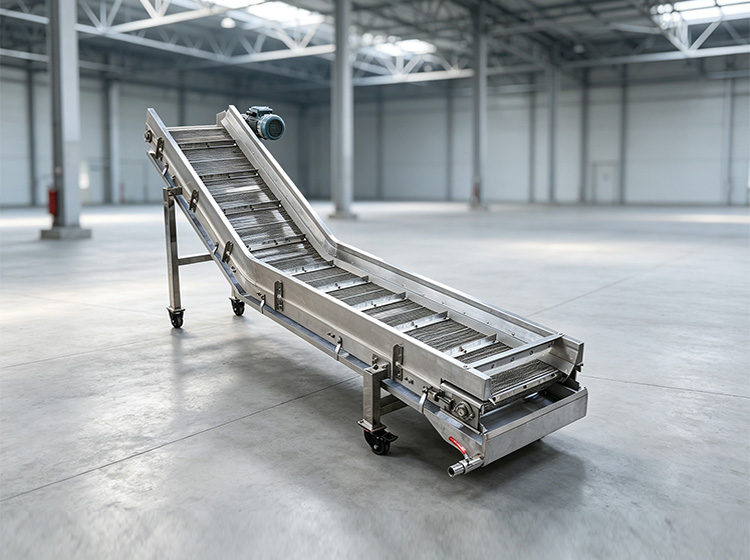
The type, structure, specifications, and number of layers of the food production line should be reasonably selected according to operating conditions. The production line operating speed shall not exceed 2.5 m/s. For large-sized, highly abrasive materials or applications using fixed discharge devices, low-speed operation is recommended.

The diameter of the conveyor drive pulley, its relationship with the layer layout of the food production line, the matching between drive and redirect pulleys, and the troughing angle requirements for idlers must all be reasonably selected in accordance with the conveyor’s design specifications.

The feed direction should align with the operational direction of the food production line. To minimize impact on the conveyor caused by falling material, chutes should be used to reduce the drop height; the receiving section of the production line should feature reduced roller spacing and cushioned rollers to prevent material leakage. Side guides must be made of a soft yet suitable material that conforms to the belt surface, avoiding damage to the belt surface caused by overly rigid side guides.

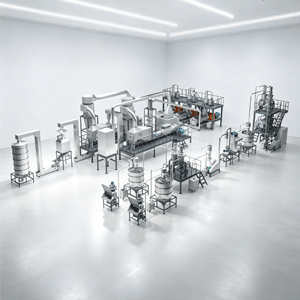
Jinan Dayi Machinery Technology Co., Ltd. is located in the beautiful spring city of Jinan. The company has long been engaged in the research and development of food production line machinery and processing technologies, adopting standardized manufacturing techniques and automated control concepts to focus on developing stable and reliable production equipment. The company’s design team possesses extensive experience in design, R&D, commissioning, and production, and is supported by responsible on-site engineering personnel who handle production and commissioning tasks, enabling us to provide you with standardized design, production, and commissioning process services.

What conditions should be considered during implementation or selection?

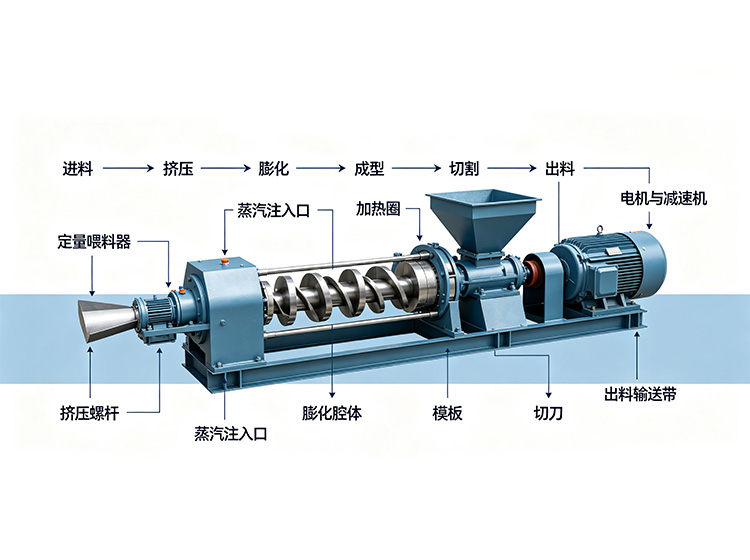
First, the product type, raw material condition, formulation direction, and expected finished product requirements must be clearly defined. For projects involving extrusion, forming, drying, frying, conveying, flavoring, or packaging, the processing capacity and cycle time of each stage must be matched to avoid inconsistencies between the capacity of individual equipment and the overall line requirements.

Next, the installation plan should be evaluated based on workshop space, power supply, water supply, steam or gas availability, and other utility conditions. Equipment configuration must also account for long-term operational factors such as cleaning, maintenance, safety protection, spare parts availability, and operator training. Any process parameters or equipment capabilities mentioned herein are intended solely for preliminary discussion and initial assessment; specific model numbers, power ratings, production capacities, temperatures, and time settings shall be determined strictly in accordance with the formal technical proposal and verified through machine testing or on-site validation.

Frequently Asked Questions

Can the equipment be directly confirmed based on the standard configuration?

Not recommended. Different raw materials, product structures, target production capacities, and downstream processes affect equipment configuration. It is more reliable to first confirm the product and process conditions, then conduct a configuration assessment.

How can I obtain more targeted advice?

We recommend preparing product images or sample information, raw materials and formulation details, target production capacity, existing workshop conditions, and planned downstream equipment configuration. Based on this information, Dayi Machinery can further discuss suitable process routes and equipment configuration options.

This article is compiled based on Dayi Machinery’s “Food Production Line Maintenance and Care Guide” and aims to assist readers in understanding the relevant topics; for technical requirements concerning specific projects, refer to the actual product documentation and engineering confirmation results.