Production Line Classification

Published:2026-07-18

Production line classification involves process, equipment selection, or operational management issues related to food processing and production equipment. Actual solutions must be confirmed based on raw material characteristics, target products, production scale, and on-site conditions—not solely on the basis of a single equipment parameter.

Core Points for Production Line Classification

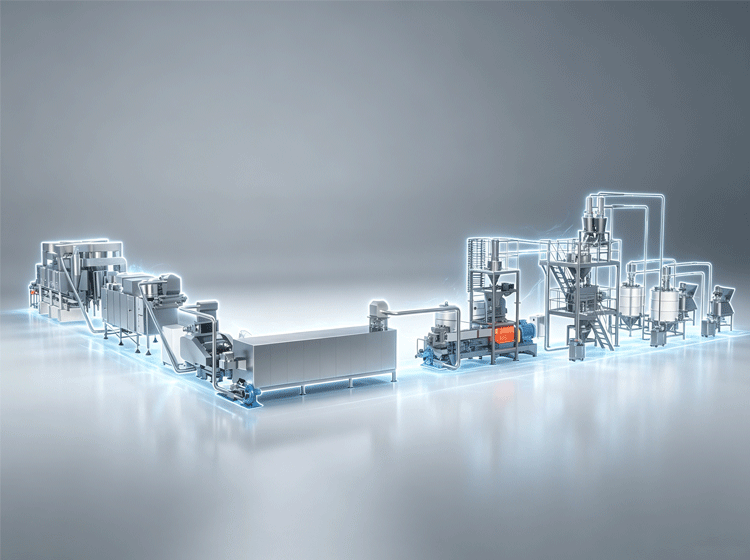
A production line refers to the route of a product’s manufacturing process—that is, the path formed by a series of production activities, starting from the entry of raw materials into the production site and proceeding through processing, conveying, assembly, inspection, and other operations. Its fundamental principle is to decompose a production process into several subprocesses, where each preceding subprocess creates the execution conditions for the next subprocess, and each subprocess can be carried out concurrently with others. In short: “functional decomposition, spatial sequencing, and temporal overlapping concurrency.”

A complete production line can consist of one or more process sections (also referred to internally as “modules”). A process section comprises several workstations, and a workstation is the smallest operational unit in production.

Based on the degree of automation, production scale, and production characteristics, production lines can be categorized into the following types:

Classified by degree of automation: fully automatic production lines and semi-automatic production lines. A fully automatic production line consists entirely of automated equipment, with all production machines interconnected via an automatic loading machine, buffer conveyor belt, and automatic unloading machine to form a fully automated production line. A semi-automatic production line refers to a production line where the main production equipment is either not interconnected or incompletely interconnected, requiring manual operation for some processes.

Classified by production line scale: production lines can be categorized into large-scale, medium-scale, and small-scale lines. Large-scale production lines feature higher capacity. Taking an SMT production line as an example, a large-scale single-sided SMT placement line consists of one flexible-placement machine and multiple high-speed placement machines. Medium- and small-scale production lines are primarily suitable for scientific research institutes and SMEs to meet production requirements for multiple product types in small batches or for a single product type.

By product type: For example, PCB production lines are categorized into single-line and double-line configurations. A PCB single-line consists of automated surface mount assembly equipment—including printers, SMT pick-and-place machines, reflow soldering furnaces, and testing equipment—primarily used for mounting SMC/SMD components on a single side of PCBs. A PCB double-line comprises two PCB single-lines, which can operate independently or in series, and is primarily used for mounting SMC/SMD components on both sides of PCBs.

What conditions should be considered during implementation or selection?

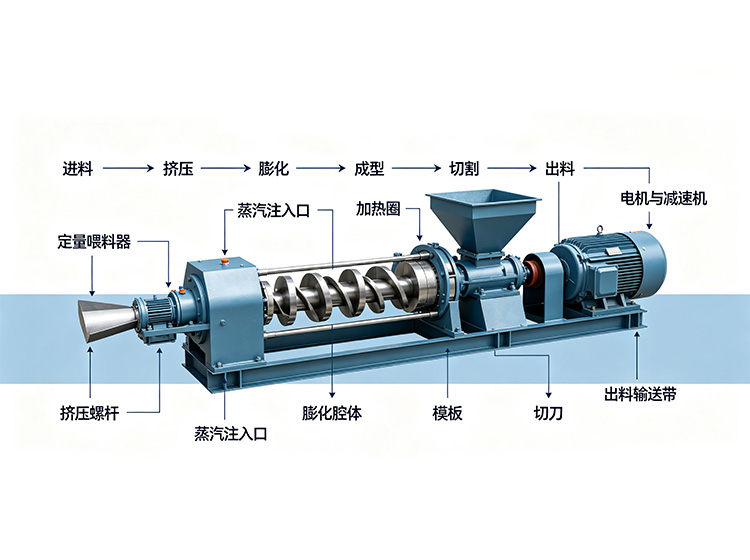
First, clarify the product type, raw material condition, formulation direction, and expected finished product requirements. For projects involving extrusion, forming, drying, frying, conveying, flavoring, or packaging, the processing capacity and cycle time of each stage must be matched to avoid mismatches between the capacity of individual equipment and the overall line requirements.

Next, the installation plan should be evaluated based on workshop space, power supply, water supply, steam or gas utility conditions. Equipment configuration should also consider long-term operational factors such as cleaning, maintenance, safety protection, spare parts availability, and operator training. Any process or equipment capacity data mentioned herein is intended solely for preliminary discussion and initial assessment; specific model numbers, power ratings, production capacities, temperatures, and time parameters shall be determined according to the formal technical proposal and confirmed via machine testing or on-site verification.

Frequently Asked Questions

Can the equipment be finalized based on the standard configuration?

Not recommended. Different raw materials, product structures, target production capacities, and downstream processes affect equipment configuration. It is more reliable to first confirm the product and process conditions, then conduct a configuration assessment.

How can I obtain more targeted recommendations?

We recommend preparing product images or sample information, raw material and formulation details, target production capacity, existing workshop conditions, and planned downstream equipment configuration. Based on this information, Dayi Machinery can further discuss suitable process routes and equipment configuration options.

This article is compiled based on Dayi Machinery’s “Production Line Classification” documentation, intended to assist readers in understanding the relevant topics; for technical requirements of specific projects, refer to the actual product documentation and engineering confirmation results.